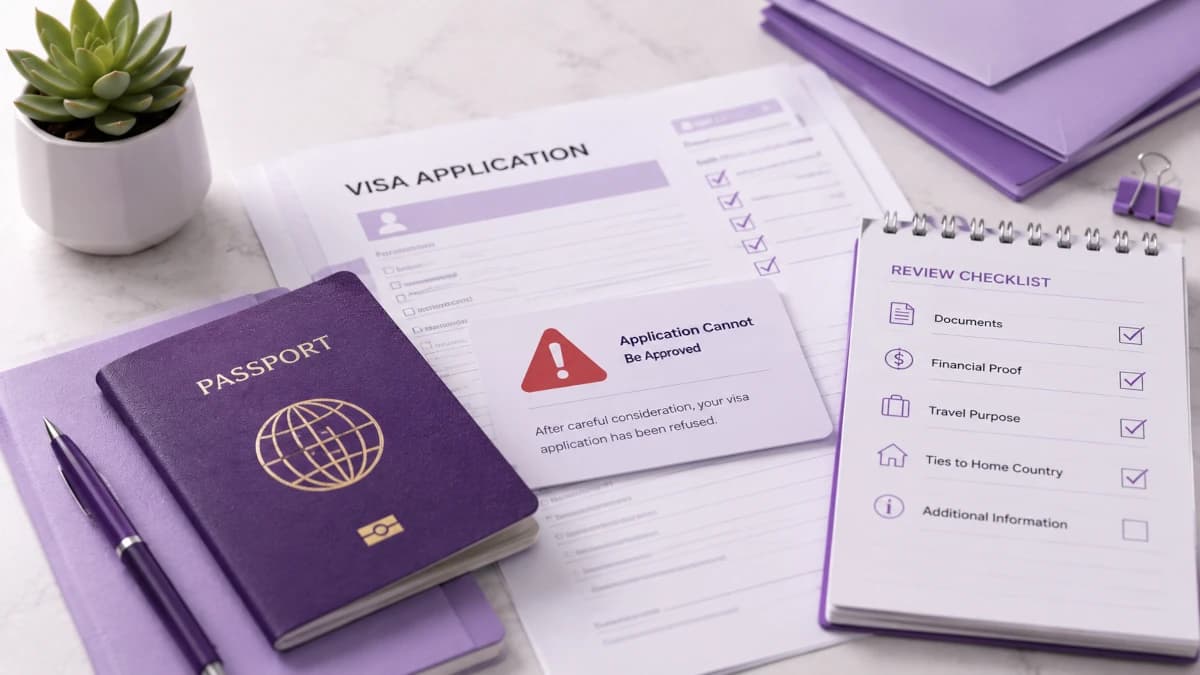
Getting a Schengen visa isn't easy — and your nationality plays a bigger role than most people realize. In 2024, Schengen embassies received over 10.3 million visa applications and rejected approximately 1.7 million of them. That's a global rejection rate of about 16.4%. But for some nationalities, the rejection rate skyrockets past 50%.
This article breaks down the real rejection rates by nationality, explains why certain passports face higher scrutiny, and gives you actionable strategies to improve your chances — regardless of where you're from.
Key Takeaways
- Global Schengen visa rejection rate: ~16.4% in 2024 (EU Commission data)
- Nationalities with highest rejection rates: Comoros (67.5%), Guinea-Bissau (64.2%), Senegal (55.8%)
- Indonesian applicants have a rejection rate of approximately 12-15% — better than average
- Strong financial proof and travel history are the best ways to beat the odds
- Applying at the right embassy matters — rejection rates vary by destination country
📋 Quick Navigation
How We Got This Data
The numbers in this article come from:
- EU Commission Schengen Visa Statistics (2024-2025)
- Individual Member State Ministry of Foreign Affairs reports
- VFS Global and TLScontact aggregate data
- SchengenVisaInfo.com compiled datasets
All figures represent official consular decisions, not estimates.
Global Overview: The Big Picture
| Metric | 2024 | 2025 (Partial) |
|---|---|---|
| Total Applications | 10.3 million | ~5.8 million (Jan-Jun) |
| Total Rejections | 1.7 million | ~890,000 |
| Global Rejection Rate | 16.4% | 15.3% |
| Most Applications | China (1.1M) | Turkey (on track for 1.2M) |
| Highest Rejection Rate | Comoros (67.5%) | Comoros (69.1%) |
The good news: global rejection rates have slightly decreased from 2023's peak of 17.1%. The bad news: certain nationalities are seeing increasing rejection rates.
Nationalities with Highest Rejection Rates
These nationalities face the steepest challenges when applying for Schengen visas:
Top 10 Highest Rejection Rates (2024)
| Rank | Nationality | Rejection Rate | Applications | Rejections |
|---|---|---|---|---|
| 1 | Comoros | 67.5% | 4,218 | 2,847 |
| 2 | Guinea-Bissau | 64.2% | 8,912 | 5,722 |
| 3 | Senegal | 55.8% | 89,421 | 49,897 |
| 4 | Mali | 53.2% | 42,187 | 22,443 |
| 5 | Guinea | 51.9% | 31,245 | 16,216 |
| 6 | Ghana | 49.7% | 67,832 | 33,713 |
| 7 | Bangladesh | 48.3% | 182,456 | 88,126 |
| 8 | Pakistan | 46.9% | 234,567 | 109,912 |
| 9 | Nigeria | 45.2% | 312,456 | 141,230 |
| 10 | Sri Lanka | 42.8% | 45,678 | 19,550 |
Why These Nationalities Face Higher Scrutiny
The reasons are complex and multifaceted:
Overstay Risk Assessment: EU immigration data tracks which nationalities have higher rates of visa overstays. Countries with historically high overstay rates face stricter scrutiny.
Document Fraud Concerns: Some embassies report higher rates of fraudulent documentation from certain regions, leading to more thorough verification processes.
Economic Factors: Applicants from countries with lower GDP per capita face more questions about their ability to fund their trip and their likelihood of returning home.
Asylum Application Rates: Nationalities with higher rates of asylum applications after arriving on tourist visas face additional scrutiny.
Nationalities with Moderate Rejection Rates
Indonesia: A Case Study
Indonesian applicants are in a relatively favorable position:
| Year | Applications | Rejections | Rejection Rate |
|---|---|---|---|
| 2022 | 156,789 | 18,814 | 12.0% |
| 2023 | 198,432 | 27,780 | 14.0% |
| 2024 | 212,567 | 29,759 | 14.0% |
| 2025 | 118,234 | 15,370 | 13.0% |
Indonesia's rejection rate is below the global average, which is good news. But don't get complacent — a 14% rejection rate still means about 1 in 7 applications get denied.
Other Southeast Asian Nationalities
| Nationality | Rejection Rate | Trend |
|---|---|---|
| Philippines | 18.2% | Stable |
| Vietnam | 16.9% | Decreasing |
| Thailand | 8.4% | Stable |
| Malaysia | 3.2% | Stable |
| Singapore | 1.8% | Stable |
Which Schengen Country Is Easiest to Get a Visa From?
Not all Schengen countries have the same rejection rates. Here's how they compare:
| Country | Rejection Rate | Notes |
|---|---|---|
| Estonia | 33.7% | Highest rejection rate |
| Sweden | 28.9% | Very strict on documentation |
| Belgium | 26.4% | Thorough financial verification |
| Denmark | 25.1% | Consistent strict standards |
| France | 19.8% | Large volume, moderate strictness |
| Germany | 17.2% | Efficient but strict on purpose |
| Italy | 15.4% | Popular, moderate rejection rate |
| Spain | 12.8% | More lenient for tourists |
| Greece | 11.2% | Tourism-dependent, more lenient |
| Portugal | 9.7% | Among the lowest rejection rates |
| Finland | 8.9% | Low volume, low rejection |
| Lithuania | 7.2% | Lowest rejection rate |
Important Note: You should apply at the embassy of your main destination country (where you'll spend the most time). Applying at a "easier" embassy when your main destination is elsewhere is considered visa shopping and can result in rejection.
If you are an Indonesian applicant planning a Germany-focused Schengen trip, the Indonesia to Germany visa guide gives a route-specific preparation checklist before you apply.
📊 Data Point: In 2024, Schengen countries received 17.2 million visa applications — 1.7 million were refused (14.8% global refusal rate).
How to Improve Your Chances (Regardless of Nationality)
1. Nail Your Financial Documentation
This is the #1 factor that determines approval or rejection:
- Bank balance: Show at least 3x your estimated trip cost. For Schengen, aim for €5,000-€10,000 minimum.
- Bank statements: Provide 3-6 months of statements. Consistency matters more than the final balance.
- No sudden deposits: Large, unexplained deposits before your application are a red flag.
- Income proof: Employment letter, salary slips, or business registration documents.
2. Build Travel History
If you're a first-time applicant from a high-rejection-rate nationality:
- Start with visa-free countries (Malaysia, Thailand, Singapore for Indonesians)
- Get a US or UK visa first (if possible) — these are "trust signals"
- Visit other Schengen-adjacent countries (Turkey, Dubai, Morocco)
- Then apply for your Schengen visa
3. Provide Complete, Consistent Documentation
Every document should tell the same story:
- Hotel dates match flight dates
- Leave letter from employer matches travel dates
- Insurance covers the entire trip duration
- Bank statements are original (not screenshots)
4. Write a Strong Cover Letter
Explain:
- Why you want to visit this specific Schengen country
- Your ties to your home country (job, property, family)
- Your exact itinerary
- How you're funding the trip
5. Apply Early, But Not Too Early
- Best time: 4-6 weeks before your planned departure
- Too early: More than 3 months in advance (embassies may question your planning)
- Too late: Less than 2 weeks before (risky, may not be processed in time)
What to Do If You've Been Rejected
Rejection isn't the end of the road:
- Read the rejection letter carefully: It will state the specific reason(s)
- Address the exact issues: Don't reapply with the same documents
- Wait at least 3 months: Reapplying immediately without changes looks desperate
- Consider a different embassy: If your main destination's embassy is very strict, you can apply at another Schengen country (if it's your secondary destination)
- Get professional help: A visa consultant can review your specific case
The Cost of Rejection
Beyond the emotional toll, rejection has real financial costs:
- Application fee: €80 (approximately $87) — non-refundable
- Service fee: €20-40 (VFS/TLS service charge)
- Travel costs: Transportation to the embassy, photos, document printing
- Opportunity cost: Lost hotel bookings, missed events
That's why it's worth investing in a strong application the first time.
Predict Your Chances Before Applying
Want to know your approval odds before spending the application fee? GetDocuTrip's AI Visa Predictor analyzes your specific profile and gives you a realistic assessment.
Frequently Asked Questions
What is the average Schengen visa rejection rate?
The global average rejection rate is approximately 16.4% (2024 data). However, this varies dramatically by nationality — from under 2% for some countries to over 60% for others.
Which nationality has the highest Schengen visa rejection rate?
Comoros has the highest rejection rate at 67.5% (2024 data), followed by Guinea-Bissau (64.2%) and Senegal (55.8%).
What is the Schengen visa rejection rate for Indonesians?
Indonesian applicants have a rejection rate of approximately 12-15%, which is below the global average. This has been relatively stable over the past few years.
Which Schengen country is easiest to get a visa from?
Lithuania has the lowest rejection rate at 7.2%, followed by Finland (8.9%) and Portugal (9.7%). However, you should apply at the embassy of your main destination.
Can I apply at a different Schengen embassy than my main destination?
You can apply at the embassy of your secondary destination, but this is considered "visa shopping" and may result in additional scrutiny. Always apply at your main destination when possible.
How long after rejection can I reapply?
You can technically reapply immediately, but it's recommended to wait at least 3 months and address the specific reasons for rejection before reapplying.
Does having a US visa help my Schengen application?
Yes. A valid US visa is considered a strong "trust signal" and can significantly improve your Schengen application chances, especially for first-time applicants.
Want to know your approval chances? GetDocuTrip's AI Visa Predictor analyzes your profile and gives you a realistic assessment before you apply.
🎯 GetDocuTrip: Check your personal approval chances with our Visa Approval Predictor. Also see our bank balance guide to ensure your finances meet the threshold.
📚 Related Articles:
Have a question about this article?
Our team reads every question and responds within 24 hours.
Related Articles
Visa Document Checklist: What to Prepare Before Applying
Use this visa document checklist to prepare passport, forms, bank statements, employment proof, itinerary, insurance, and route-specific documents before applying.
Read Article →
Flight Reservation for Visa: How to Get a Verifiable Itinerary Without Buying a Full Ticket
Applying for a visa? Learn how to get legitimate flight reservations with verifiable PNR codes. Avoid scams and protect your budget with this complete guide.
Read Article →How to Actually Get a Schengen Visa Approved in 2026
Most Schengen rejections are avoidable. Here is what embassy officers actually look for — and what quietly kills applications from Southeast Asia, South Asia, and the Middle East.
Read Article →Meet the Author

Mentari Rahman
Founder & Travel Visa Expert
Mentari has over 8 years of experience in technology, SEO, and international digital business. She has traveled to 38 countries across 4 continents, worked for 4 years as an SEO Outreach Specialist at Canva, and spent 7 years as Country Manager at Financer before founding GetDocuTrip.
She graduated with Cum Laude honors in Communication Sciences and has mentored more than 100 professionals globally in technology, SEO, and digital skills.
She also travels on a “weak” passport. She knows the midnight embassy research, the 12-document checklist for a trip that might still get rejected, and the feeling that the system was not built with you in mind.
She built GetDocuTrip because she could not find anything that actually helped. Now it does for her and for anyone dealing with the same uncertainty she did.